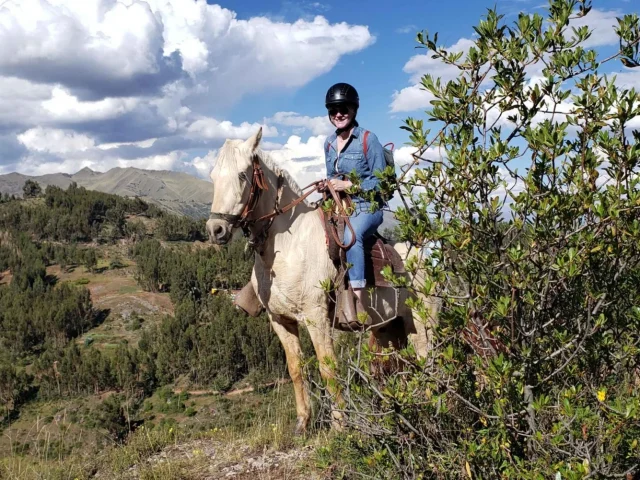
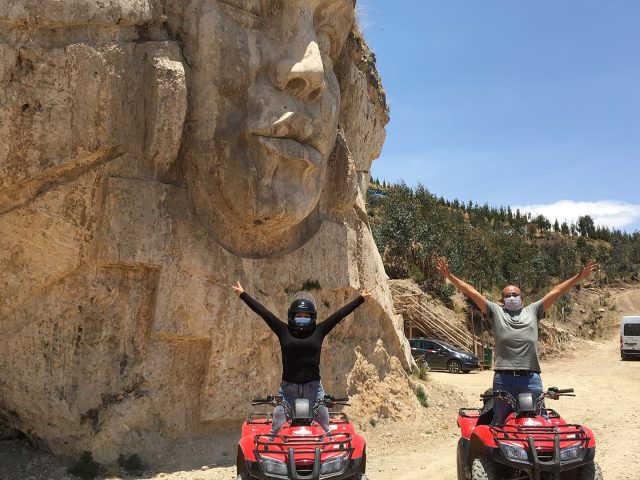
This horseback riding tour offers an alternative way to visit the four archaeological complexes on the outskirts of Cusco. This fabulous half-day tour takes you through the most important sites in Cusco with a bilingual guide (Spanish and English), first-class horses, and detailed explanations at each location we visit: Saqsayhuamán, Qenqo, Tambomachay, and Puka Pukara, all while traveling through the magnificent Andean landscape.
At the beginning of the tour, transportation will pick you up from your hotel and take you to the ranch. Here, we will meet our horses and learn how to ride them.
A minimum age of 10 years is recommended for this tour.
The adventure begins with hotel pick-up at the time indicated in your itinerary. We will take you to the ranch, located near the Temple of the Moon, in a 20-minute ride, where we will have a brief introduction to horseback riding. After about 10 minutes of instruction, we will depart on horseback to the four archaeological sites in the following order: Puka Pukara (20 minutes), Tambomachay (30 minutes), Qenqo (30 minutes), and finally Saqsayhuamán (40 or 50 minutes), with stops to enjoy the incredible landscapes. At Saqsayhuamán, we will leave the horses, and our transport will pick you up to take you back to Cusco.
To visit the 4 archaeological sites in Cusco, this tour requires a General Tourist Ticket or a Partial Tourist Ticket. For more information about the Tourist Tickets, see the ‘Recommended to Bring’ tab.
If you plan to visit most of the major tourist attractions in Cusco during your stay, we recommend purchasing the General Tourist Ticket to save on entry fees and simplify your trip.
To purchase your Tourist Ticket, as well as tickets to the Cathedral and Qorikancha, you must bring Peruvian Soles.
The City Tour of Cusco on horseback includes the following attractions:
Sacsayhuamán is one of the most enigmatic sites of the Incas. Visitors can marvel at stones up to nine meters tall and weighing over 120 tons, all fitted together with incredible precision. The Spanish believed the site was the work of the devil, and fierce battles took place here between the Incas and Europeans. Today, it is one of the most symbolic attractions in Cusco and Peru. Every June 24th, it hosts the famous “Festival of the Sun,” also known as the Inti Raymi.
A megalithic monument of great artistic expression, it is a clear example of the achievements of Inca technology.
Qenqo is approximately 1 kilometer from Sacsayhuamán. It was an Inca ceremonial center with buildings dedicated to Mother Earth. One highlight is an area called the amphitheater, where the Incas placed their dead in trapezoidal niches. Its main attraction is its underground labyrinths. Moreover, the word “Qenqo” in Quechua (the language of the Incas) means “labyrinth.”
Puka Pukara is known as the “Red Fortress” due to the reddish pigmentation in some of its stones, as well as the reddish hue the site takes on at sunset. It is believed that this site served as a military post and resting place for the Inca troops. Its primary function was to protect Tambomachay and Sacsayhuamán. Visitors can also see other structures such as fountains, aqueducts, and other Inca constructions.
Considered a huaca in Inca times, Puka Pukara was a control site for areas and also housed several administrative spaces.
Tambomachay is one of the most beautiful archaeological sites. It is located approximately 400 meters from Puka Pukara. Its Inca constructions celebrate water with such perfection that even today, after several centuries, its canals still flow with water. The site also features a collection of finely carved rocks, waterfalls, canals, and aqueducts fed by springs. The scenic beauty of the site harmonizes with its buildings and the murmur of the water.
This sacred space was dedicated to the worship of water, as this element was vital for human existence.


With Paypal we accept all debit & credit cards.
A 7% transaction fee applies.
Do not hesitate to give us a call. We are an expert team and we are happy to talk to you.
+51 957 717 172
info@intrandesperutours.com